foresights
The decisions leaders make today are shaped by what they understand about tomorrow. That's precisely why we built foresights—a dedicated space for sharing the ideas, trends, issues, and signals influencing the futures of leaders and their organisations.
Search the blog;
Visit here to see blog posts available in alternate languages.

Mastering the Art of Asking Questions: Simple Tips for Success.
You should read this if… you want to improve your decision‑making, learning, and strategic foresight by asking better questions rather than rushing to answers. This article explains why effective questioning is a core leadership skill, outlining the traits of good questions, common pitfalls to avoid, and simple techniques that help surface deeper insight and challenge assumptions. It shows how cultivating a questioning mindset—individually and across teams—can unlock new opportunities, strengthen problem‑solving, and create the conditions for more thoughtful, future‑focused conversations and decisions.

A Note From Our Founder.
Why was insight & foresight created? Who are our customers? How do we deliver value? Read this note from our founder James Clampett.

Using STEEP to Frame Your Horizon Scanning.
You should read this if… you are a leader who wants a disciplined, practical way to scan the external environment without missing critical drivers of change. This article explains how using the STEEP framework—Social, Technological, Economic, Environmental, and Political—brings structure and balance to horizon scanning, helping leaders organise weak signals, trends, and emerging issues into a coherent picture of what could shape their organisation’s future. It shows how STEEP‑framed scanning improves long‑term decision‑making by reducing blind spots, clarifying uncertainty, and enabling organisations to anticipate risks and opportunities with greater confidence and reliability.
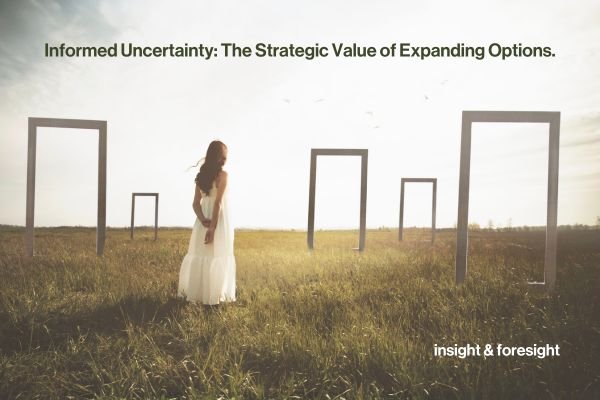
Informed Uncertainty: The Strategic Value of Expanding Options.
You should read this if… you are questioning the value of rigid strategic plans in a world that no longer behaves predictably. This article introduces informed uncertainty as a more effective strategic posture—one that accepts unpredictability and deliberately expands an organisation’s range of options rather than committing to a single, fragile path. It explains how embracing uncertainty, building optionality, and exploring multiple plausible futures increases strategic flexibility, resilience, and the ability to shape outcomes over time, shifting leadership from the illusion of certainty to making better decisions in conditions that cannot be fully known.

Informed Uncertainty: Balancing Knowing and Not-Knowing.
You should read this if… you are an executive leader grappling with how to lead confidently when neither data nor experience can fully explain what comes next. This article introduces informed uncertainty as a leadership capability that deliberately balances knowing and not‑knowing—using insight, evidence, and experience as a foundation while remaining open to surprise, emergence, and change. It argues that the ability to hold certainty and uncertainty at the same time enables better judgement, adaptability, and resilience, helping leaders question assumptions, stay curious, and make robust decisions in complex, fast‑moving environments where the future cannot be predicted but can still be shaped.

Action Verbs. Words That Get Things Done.
You should read this if… you want strategy and planning to translate into clear action rather than well‑intentioned ambiguity. This article explores the power of action verbs—specific, decisive language that turns intentions into commitments and plans into momentum. It explains how vague phrasing can dilute accountability and slow execution, while strong action verbs bring precision, clarity, and energy to strategic conversations, helping leaders communicate intent more effectively and ensure that plans are understood, owned, and acted upon.

What is Informed Uncertainty?
You should read this if… you are a leader seeking a clear way to understand what informed uncertainty actually means in practice, and why it matters for leadership and strategy today. This article defines informed uncertainty as the deliberate balance between what we know and what we cannot know, showing how foresight helps leaders navigate complexity, disruption, and interconnected change without relying on false certainty. It explains how embracing uncertainty—while remaining grounded in insight and evidence—enables more adaptive thinking, better judgement, and the ability to pivot with a portfolio of possibilities rather than committing to a single, fragile view of one future.

Case Study: The Scenario Creation Process.
You should read this if… you are a CEO, executive or board member who wants a practical, repeatable way to explore uncertainty and strengthen strategy without relying on a single forecast. This article walks through the scenario creation process, showing how teams can systematically explore and analyse multiple plausible futures to test assumptions, surface risks and opportunities, and build more resilient strategies. It demonstrates how well‑constructed scenarios expand thinking, support better conversations at the leadership level, and equip organisations to navigate complexity by preparing for a range of futures rather than betting on one expected outcome.

How Smart Robots Can Redefine Domestic Space Usage.
You should read this if… you are curious about how emerging robotics will reshape everyday life and the way we design and use our homes. This article explores how smart robots—ranging from autonomous cleaners to cognitive and emotional support companions—are beginning to redefine domestic space by taking on tasks, influencing room design, and changing how people interact with their living environments. It looks beyond novelty to examine how advances in AI, machine learning, and human‑robot interaction could fundamentally alter household routines, space utilisation, and expectations of home life as smart robots become more capable and integrated.

Case Study: How Scenario Planning Transformed a Council’s Operations Plan Review.
You should read this if… you are a leaders partway through a strategy cycle and want to pressure‑test your current operations plan against a rapidly changing future. This case study shows how scenario planning can be used mid‑strategy to pause, reflect, and recalibrate—helping leadership teams look beyond short‑term delivery and examine how emerging uncertainties and long‑term forces could affect today’s priorities. It demonstrates how using scenarios to review an operations plan surfaces hidden assumptions, strengthens alignment, and ensures near‑term actions remain robust and relevant across a range of plausible futures rather than being locked into a single, increasingly fragile view of what lies ahead.

Sejahtera - the art of sustainability and well-being. A report on Asia Pacific Futures Network Conference 9
Journey with us to explore the concept of sejahtera and how this Malaysian concept promotes sustainability and well-being in our lives. Discover more through our reflection on Asia Pacific Futures Network Conference 9 (APFN9) held in Kuala Lumpur in September 2023.

delta∆effect 23.3: The Benefits Of A Futures-Focused Business Plan.
You should read this if… you are a business leader who suspects that traditional, forecast‑driven business plans are no longer keeping pace with the speed and unpredictability of change. This article explains why futures‑focused business planning is replacing linear, past‑data‑driven approaches, and how foresight helps organisations anticipate non‑linear and exponential change rather than be surprised by it. It explores how shifting to a futures‑focused plan enables leaders to be more proactive, build resilience, and make better decisions in an environment shaped by rapidly evolving social, technological, economic, environmental, and political forces—preparing the organisation not to predict a future, but to navigate a range of futures with confidence.

delta∆effect 23.2: Using Foresight To Drive Strategy Development.
You should read this if… you are a CEO or board member looking to move strategy beyond static plans and into a more adaptive, future‑ready discipline. This article explains how using foresight in strategy development helps leaders navigate uncertainty with greater confidence by recognising that futures are not fixed, but shaped by the choices we make today. It shows how a foresight‑driven approach expands strategic options, challenges assumptions, and aligns decision‑making with a rapidly changing world—enabling organisations to develop strategies that are more resilient, relevant, and capable of evolving as conditions shift rather than becoming outdated.

delta∆effect 23.1: A Great 5-year Plan Requires Thinking 10 years Ahead.
You should read this if… you are a CEO or board member building a 5‑year plan but wants greater confidence that it will remain relevant in a rapidly changing world. This article argues that the strength of a 5‑year plan comes from thinking at least 10 years ahead, using foresight to anticipate longer‑term shifts in markets, regulation, technology, and society. It explains how extending strategic time horizons helps leaders surface uncertainty earlier, identify emerging opportunities and risks, and make better decisions today—so short‑ and medium‑term plans are more resilient, adaptive, and aligned with long‑term growth and sustainability.

From 'The Future' to 'Their Futures'.
You should read this if… you want to move beyond the idea of a single, leader‑defined “future” and instead create strategies that reflect the needs of many stakeholders. This article challenges the notion of the future as a singular destination and introduces the shift toward their futures—multiple, co‑created futures shaped by diverse human perspectives. It explains how adopting foresight as a leadership capability helps organisations recognise interconnected systems, embrace inclusion, and collaborate with stakeholders to design more resilient, equitable, and sustainable futures—moving from control and prediction to listening, engagement, and shared creation.

Why Long-Term Thinking Matters Most Right Now.
You should read this if… you are leading a business and feeling pressure to focus on immediate issues while sensing that short‑term fixes are no longer enough. This article explains why the current climate of disruption, complexity, and interconnected change makes long‑term thinking more important than ever, and how an over‑reliance on short‑term decision‑making can undermine resilience and future impact. It argues that intentionally extending leadership time horizons helps organisations address root causes, anticipate emerging risks and opportunities, and make choices today that create lasting value rather than temporary relief.
Case Study: Building Scenarios to Expand Thinking.
You should read this if… you are a leader in business who wants to challenge entrenched assumptions and help leadership teams think beyond “business as usual.” This case study shows how building scenarios can be used as a practical foresight technique to expand strategic thinking, using structured exploration of trends and uncertainties to surface alternative ways the future might unfold. It demonstrates how scenario building helps leaders broaden perspectives, test beliefs, and prepare for future challenges with greater agility—shifting strategy conversations from predicting one outcome to learning how to navigate multiple plausible futures with confidence.
Case Study: How to Engage & Educate with Design Fiction.
You should read this if… you are a CEO or executive looking for a powerful way to engage and educate stakeholders about uncertain futures without relying on abstract reports or technical jargon. This case study shows how design fiction can be used to bring future possibilities to life through storytelling, visual artefacts, and speculative narratives that make complex change tangible and discussable. It demonstrates how design fiction helps organisations spark meaningful conversations, shift mindsets, and invite collaboration by creating a safe space to explore how emerging technologies and trends could shape their sector—enabling stakeholders to actively participate in imagining and shaping what might happen next

Using Foresight to Plan & Make Decisions for Impact & Future Growth.
You should read this if… you are a business leader who wants a clear, practical way to use foresight to improve decision‑making rather than leaving it as an abstract or standalone exercise. This article outlines a foresight process flow that shows how scanning for signals, exploring uncertainty, and developing alternative futures can be deliberately linked to real strategic choices. It demonstrates how foresight becomes most valuable when it is integrated into planning and governance—helping leaders make more informed, timely, and resilient decisions by turning future insight into concrete actions for impact and long‑term growth.

Doctors Of Our Futures. Design Fiction Presentation.
Key note presentation: 0900 Friday 02 June 2023, Doctors Health in Queensland “DHQ Forum: Doctors Unmasked: being human in medicine” Brisbane, Queensland.