foresights
The decisions leaders make today are shaped by what they understand about tomorrow. That's precisely why we built foresights—a dedicated space for sharing the ideas, trends, issues, and signals influencing the futures of leaders and their organisations.
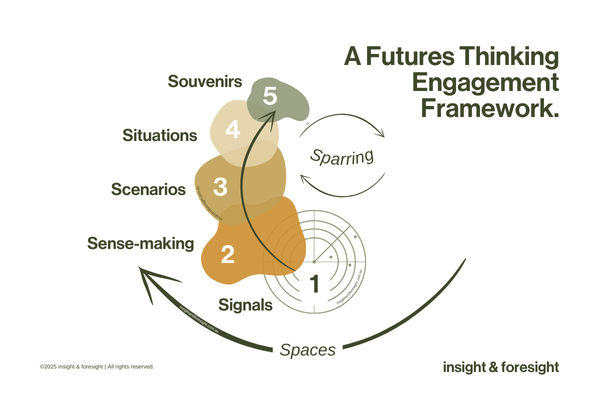
A Futures Thinking Engagement Framework.
You should read this if… you are a CEO, executive or board member seeking a clear, practical way to embed futures thinking into strategy rather than treating it as a one‑off exercise. This article explains the Futures Thinking Engagement Framework, a structured yet adaptable approach designed to help organisations navigate uncertainty by exploring signals of change, making sense of emerging patterns, and engaging leadership teams in shared learning. It emphasises that the framework is less about producing static outputs and more about building experience, capability, and confidence—enabling organisations to anticipate change, align decision‑makers, and prepare for a range of plausible futures through an ongoing, human‑centred process rather than a fixed plan.

Knowledge Base: Strategic Thinking: what is it and how to do it by Maree Conway.
You should read this if… you want to strengthen strategy by improving how your organisation thinks, not just how it plans. This article draws on Maree Conway’s work to clearly distinguish strategic thinking from strategic planning, arguing that effective strategy depends on the ability to imagine and explore future possibilities before locking in actions and plans. It explains strategic thinking as a deliberate, ongoing practice that helps leaders make sense of uncertainty, challenge assumptions, and consider multiple futures, providing the foundation for more coherent, future‑ready decisions rather than plans built solely on past trends or short‑term operational priorities.

Knowledge Base: Six Pillars: Futures Thinking for Transforming by Sohail Inayatullah.
You should read this if… you are a CEO or board member looking for a proven, structured way to move beyond short‑term planning and actively shape your organisation’s future. This article introduces Sohail Inayatullah’s Six Pillars of Futures Thinking—mapping, anticipating, timing, deepening, creating alternatives, and transforming—as a comprehensive framework for understanding change and designing preferred futures rather than defaulting to inherited or “used” ones. It explains how the six pillars help leaders recover strategic agency, challenge dominant assumptions, explore alternative pathways, and align action with long‑term transformation in an increasingly complex and uncertain world.

Knowledge Base: A Generic Foresight Process Framework by Joseph Voros.
You should read this if… you are a strategic thinker seeking a clear, end‑to‑end way to integrate futures thinking into strategy rather than treating foresight as an isolated activity. This article introduces Joseph Voros’s Generic Foresight Process Framework, which lays out a structured sequence from scanning and sense‑making through to generating insights that directly inform strategy development and planning. It explains how the framework helps organisations systematically explore alternative futures, diagnose gaps in how foresight and strategy are currently practiced, and design more robust, adaptable decision‑making processes—turning foresight into a practical, repeatable capability rather than a one‑off exercise.

Icons of Futures Thinking.
You should read this if… you are a CEO or board member who wants a clear, accessible way to engage your leadership teams in futures thinking without wading through academic complexity. This article introduces Icons of Futures Thinking as a set of five practical, visual frameworks—the Futures Triangle, Two × Two Matrix, Three Horizons, Four Archetypes, and the Futures Wheel—that make it easier to explore uncertainty, challenge assumptions, and discuss alternative futures. It explains how these icons provide a shared language for leaders to identify signals of change, explore plausible disruptions, and think beyond short‑term horizons, turning futures thinking from an abstract concept into a usable, repeatable capability for strategic decision‑making.

Using STEEP to Frame Your Horizon Scanning.
You should read this if… you are a leader who wants a disciplined, practical way to scan the external environment without missing critical drivers of change. This article explains how using the STEEP framework—Social, Technological, Economic, Environmental, and Political—brings structure and balance to horizon scanning, helping leaders organise weak signals, trends, and emerging issues into a coherent picture of what could shape their organisation’s future. It shows how STEEP‑framed scanning improves long‑term decision‑making by reducing blind spots, clarifying uncertainty, and enabling organisations to anticipate risks and opportunities with greater confidence and reliability.

What's the Difference Between Business Uncertainty and Risk?
You should read this if… you are a leader who wants to make better decisions by clearly distinguishing between what can be managed and what must be navigated. This article explains the difference between business risk and uncertainty, showing how risk involves known variables that can be analysed and mitigated, while uncertainty reflects unknown or unknowable conditions that cannot be reliably predicted. It argues that conflating the two leads to false confidence and fragile strategies, and that leaders who recognise uncertainty as a distinct challenge are better equipped to use foresight, expand options, and make more resilient decisions in complex and rapidly changing environments.

6 Principles of Business Growth.
You should read this if… you are running a business and looking for a grounded, long‑term view of how sustainable business growth actually happens. This article outlines six core principles of business growth—universality, scalability, replicability, gradualism, optionality, and flexibility—arguing that growth is not driven by shortcuts or one‑off wins, but by systems and choices that can endure and adapt over time. It shows how applying these principles helps leaders design growth strategies that remain resilient in the face of uncertainty, avoid over‑extension, and create the conditions for steady, repeatable progress rather than fragile, short‑term gains.

Backcasting - A Tool for Planning and Decision Making.
You should read this if… you are a leader who has a clear vision of where you want your organisation to be but are unsure how to translate that future ambition into concrete action today. This article introduces backcasting as a foresight tool that starts with a desired future and works backward to identify the decisions, milestones, and actions needed to get there, rather than extrapolating forward from current conditions. It explains how backcasting helps leaders manage uncertainty, align strategy with long‑term goals, and design more intentional pathways through complexity by focusing on what must change to achieve a preferred future.

The Business Case for Foresight.
You should read this if… you are building the case for investing time and resources in futures thinking rather than relying solely on historical data and short‑term forecasts. This article sets out the business case for foresight, explaining why traditional data‑driven planning becomes unreliable in fast‑changing, uncertain environments. It shows how foresight complements existing analytics by exploring multiple possible, probable, and preferable futures, helping leaders make decisions with greater confidence, creativity, and reliability. By strengthening strategic agility, alignment, and the ability to shape rather than simply react to change, foresight becomes a practical capability for navigating uncertainty and supporting better long‑term outcomes.

12 Questions to Get Started Using Strategic Foresight.
There is no one-size-fits-all answer when it comes to using strategic foresight in your business. The key is to experiment, find what works for you, and adapt as needed.

Elephants, Swans and Jellyfish for planning.
You should watch this video if… you are interested in better ways to plan in the face of uncertainty, complexity, and uncomfortable realities. This article explores the concepts of Black Elephants, Black Swans, and Black Jellyfish as practical lenses for future‑informed planning—helping leaders distinguish between risks they see but avoid, shocks they don’t expect, and issues that appear manageable but can escalate unexpectedly. It shows how deliberately identifying and exploring all three concepts expands strategic thinking, supports more resilient and diversified plans, and strengthens an organisation’s ability to respond thoughtfully to disruption rather than being surprised by it.

The Futures Triangle
You should read this if… you are looking for a simple, powerful way to make sense of the forces shaping your organisation’s future. This video introduces the Futures Triangle, a foresight tool developed by Prof. Sohail Inayatullah, and explains how it helps leaders map the push of present trends, the pull of preferred futures, and the weight of past assumptions and structures. By visualising how these three forces interact, the Futures Triangle creates a shared frame for better planning and decision‑making—helping organisations clarify what is driving change, what is holding them back, and what kind of future they are actively working towards to support impact and future growth.

What’s the Difference Between Forecasting and Foresight?
You should watch this if… you are business leader who relies on forecasts but suspects they are no longer enough to guide decisions in an increasingly uncertain world. This article explains the shift from forecasting to foresight, showing why forecasts—based on extrapolating past data—struggle when conditions change, while foresight explores multiple possible futures to inform better choices today. It clarifies how foresight broadens thinking beyond single predictions, helps leaders anticipate disruption, challenge assumptions, and plan with greater resilience, making it a more reliable foundation for strategy, impact, and long‑term growth than forecasts alone.