foresights
The decisions leaders make today are shaped by what they understand about tomorrow. That's precisely why we built foresights—a dedicated space for sharing the ideas, trends, issues, and signals influencing the futures of leaders and their organisations.
Search the blog;
Visit here to see blog posts available in alternate languages.

Beyond the Hype: Why Leaders Need Strategic Foresight for AI.
You should read this if… you are concerned that treating AI as a short‑term technology initiative rather than a long‑term strategic force creates material governance and strategy risk. The article argues that most AI conversations fixate on current tools and use cases, while effective leadership requires anticipating AI’s broader future impacts on industries, economies, and society, and shifting from reactive adoption to proactive strategic agility. It positions strategic foresight as a core executive capability, providing a structured way to navigate uncertainty, surface emerging risks and opportunities, and embed AI considerations into enterprise strategy, resilience, and long‑term value creation rather than experimentation driven by hype.

Why Futures Thinking Crafted by Hands Matters.
You should read this if… you are relying on generic trend reports or automated insights and are concerned they may be masking, rather than resolving, strategic risk. The article argues that one‑size‑fits‑all foresight fails to account for an organisation’s unique culture, capabilities, and strategic context, often creating false confidence and misaligned priorities. It makes the case for “futures thinking crafted by hands” — a bespoke, human‑centred approach that combines data with collaborative insight, creativity, and deep organisational understanding — to help leaders build strategies that are more relevant, resilient, and adaptable across multiple plausible futures, rather than optimised for a single predicted outcome.

Crafting Futures: The Power of a Human-Centric Framework.
You should read this if… you are looking for a practical way to embed long‑term thinking into decision‑making without relying on generic trend reports or rigid planning models. The article argues that while futures thinking is essential in conditions of constant disruption, it is most effective when it is human‑centred and hand‑crafted, blending creativity, experience, and organisational context with a clear structure. It introduces the Futures Thinking Engagement Framework as a flexible, dynamic scaffold that helps leadership teams collaboratively identify signals of change, make sense of uncertainty, explore multiple plausible futures, and translate insight into action, building not just better strategies but lasting organisational capability for foresight and resilience.

Futures Thinking Icon No. 4: Four Archetypes.
You should read this if… you are a CEO or board member looking for a clear, disciplined way to think beyond forecasts and stress‑test strategy against fundamentally different futures. This article introduces Jim Dator’s four scenario archetypes—Growth, Discipline, Transformation, and Decline—as a practical framework for strategic foresight, showing how these recurring patterns of change can be used to explore multiple plausible futures rather than betting on a single outcome. It explains how applying all four archetypes helps leaders challenge assumptions, surface blind spots, and improve strategic agility across planning, policy, and organisational development, strengthening decision‑making in the face of long‑term uncertainty.

50 Questions to Ask About Our Futures Today.
You should read this if… you are a leader who recognises that better long‑term decisions start with better questions, not better forecasts. This article presents 50 carefully curated questions spanning technology, society, the environment, the economy, and politics, designed to challenge assumptions, surface blind spots, and expand how leaders think about change. Rather than offering predictions, it reframes futures thinking as a leadership discipline rooted in inquiry—helping organisations anticipate emerging risks, identify new opportunities, and engage more meaningfully with uncertainty by asking the questions that shape strategy, resilience, and long‑term impact.

Ambient Voice Technology: An Active Role in our Futures?
You should read this if… you are seeking to understand how AI is shifting from a passive tool to an always‑on, proactive presence embedded in everyday work and decision‑making. This article explores the rise of ambient voice technology—AI systems that listen, anticipate needs, and deliver insights or actions in real time—showing how it is reshaping workflows, productivity, and human–technology interaction across industries. It examines the opportunities this creates for more intuitive, seamless futures, while also addressing the ethical, governance, and trust considerations leaders must grapple with as ambient AI becomes an active participant in organisational life rather than a background utility.

How to Assess Your Organisation’s Readiness for Futures Thinking Success.
You should read this if… you are a CEO or board member who suspects your organisation talks about your futures more than it is truly prepared for them. This article introduces the Futures Thinking Readiness Assessment as a practical way to evaluate whether your organisation has the leadership commitment, adaptability, and resources needed to turn foresight into real strategic advantage. Through a set of targeted questions, it helps leaders identify gaps in capability, culture, and decision‑making, and highlights how assessing readiness is a critical first step in building resilience, agility, and the capacity to anticipate and act on change rather than reacting once disruption is already underway.

Futures Thinking Icon No. 2: Two X Two.
You should read this if… you are looking for a simple yet powerful way to explore uncertainty and stress‑test strategy without getting lost in complexity. This article explains the Two x Two scenario method as a practical engine for futures thinking, showing how identifying two critical uncertainties can generate four plausible futures that challenge assumptions and illuminate strategic choices. It demonstrates how the framework helps leadership teams align quickly, explore risks and opportunities in a structured way, and move from abstract uncertainty to clearer, more resilient decisions that hold up across multiple possible futures.

Why Simplified Scenario Planning is Essential for Today’s Executives.
You should read this if… you, or your organisation, has dismissed scenario planning as too complex or time‑consuming, yet knows your organisation is increasingly exposed to sudden disruption and strategic surprise. This article argues that traditional, heavyweight scenario approaches have discouraged executives from using a tool that is now essential, and makes the case for simplified, flexible scenario planning that fits real leadership constraints. It shows how streamlined scenario methods can cut through complexity, improve strategic clarity, and help leaders build agility and resilience—enabling faster, better decisions in volatile conditions without overwhelming teams or locking them into rigid plans.

Looking Outside: Scanning for Signals of Change in a Fast-Changing World.
You should read this if… you are a leader who senses that relying on internal data and past experience is no longer enough to anticipate disruption. This article argues that in a fast‑changing world, future‑ready organisations must deliberately “look outside” their boundaries and scan for early signals of change across technology, society, markets, and geopolitics. It explains how systematic horizon scanning helps leaders identify weak signals before they become disruptive forces, reduce strategic blind spots, and build the capability to adapt strategy continuously, shifting foresight from a one‑off exercise into an ongoing leadership discipline for navigating uncertainty with greater confidence.
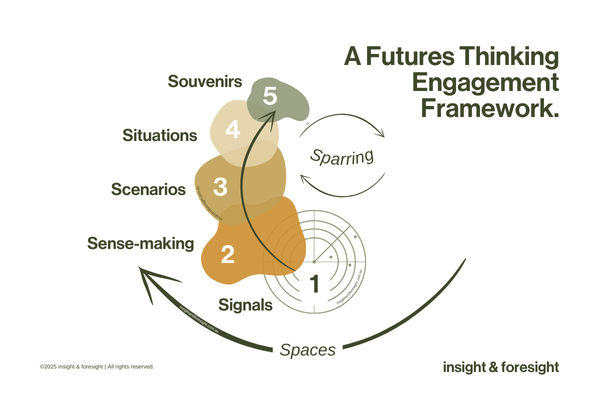
A Futures Thinking Engagement Framework.
You should read this if… you are a CEO, executive or board member seeking a clear, practical way to embed futures thinking into strategy rather than treating it as a one‑off exercise. This article explains the Futures Thinking Engagement Framework, a structured yet adaptable approach designed to help organisations navigate uncertainty by exploring signals of change, making sense of emerging patterns, and engaging leadership teams in shared learning. It emphasises that the framework is less about producing static outputs and more about building experience, capability, and confidence—enabling organisations to anticipate change, align decision‑makers, and prepare for a range of plausible futures through an ongoing, human‑centred process rather than a fixed plan.

Hearing the Noise, Listening for the Signals.
You should read this if… you are a leader feeling overwhelmed by constant headlines, trends, and opinions, and want to make better decisions by distinguishing what is truly shaping your futures from what is merely distracting. This article explores the difference between “noise” — the loud, fast‑moving information that drives reactive thinking — and “signals,” the quieter, deeper patterns that point to enduring change. It explains why leaders who learn to listen for signals rather than react to noise are better equipped to address root causes, allocate attention and resources more wisely, and shift from short‑term reactions to more thoughtful, futures‑focused strategy in an age of information overload.

The Art of the Craft.
You should read this if… you are navigating an AI‑accelerated world and want to understand why human craft remains a strategic differentiator rather than a nostalgic luxury. This article explores craftsmanship as the deliberate fusion of skill, creativity, intuition, and emotion—qualities that automation and AI cannot replicate—and explains why these human attributes matter more, not less, as technology scales efficiency and precision. It argues that leaders who actively value and protect craft within their organisations build authenticity, meaning, and long‑term distinction, positioning human judgement, imperfect insight, and purposeful creation as essential complements to intelligent machines in shaping resilient and trusted futures.

Embracing a Futurist Mindset on New Year's Eve.
You should read this if… you use New Year’s Eve as a moment for reflection but wants that future‑focused thinking to become a year‑round leadership habit rather than an annual ritual. This article explores why we naturally adopt a futurist mindset at the turn of the year—scanning signals, imagining possibilities, and setting intentions—and explains that true futures thinking is not about prediction, but about exploring possible, probable, and preferred futures. It argues that leaders who carry this mindset beyond New Year’s Eve build greater curiosity, adaptability, and resilience, enabling them to actively shape their organisation’s future rather than simply reacting to change as it unfolds.

Knowledge Base: Strategic Thinking: what is it and how to do it by Maree Conway.
You should read this if… you want to strengthen strategy by improving how your organisation thinks, not just how it plans. This article draws on Maree Conway’s work to clearly distinguish strategic thinking from strategic planning, arguing that effective strategy depends on the ability to imagine and explore future possibilities before locking in actions and plans. It explains strategic thinking as a deliberate, ongoing practice that helps leaders make sense of uncertainty, challenge assumptions, and consider multiple futures, providing the foundation for more coherent, future‑ready decisions rather than plans built solely on past trends or short‑term operational priorities.

Knowledge Base: Six Pillars: Futures Thinking for Transforming by Sohail Inayatullah.
You should read this if… you are a CEO or board member looking for a proven, structured way to move beyond short‑term planning and actively shape your organisation’s future. This article introduces Sohail Inayatullah’s Six Pillars of Futures Thinking—mapping, anticipating, timing, deepening, creating alternatives, and transforming—as a comprehensive framework for understanding change and designing preferred futures rather than defaulting to inherited or “used” ones. It explains how the six pillars help leaders recover strategic agency, challenge dominant assumptions, explore alternative pathways, and align action with long‑term transformation in an increasingly complex and uncertain world.

Futures Thinking Icon No. 3: Three Horizons.
You should read this if… you are a leader working in strategy or transformation and looking for a practical way to balance today’s operational realities with long‑term transformation. This article introduces the Three Horizons framework, originally developed by Bill Sharpe, as a powerful tool for futures thinking that helps leaders distinguish between what must be sustained in the present, what is emerging and disruptive, and what could ultimately replace today’s dominant systems. It explains how using the three horizons together enables organisations to address short‑term performance while simultaneously nurturing innovation and preparing for deep, long‑term change—reducing tension between “business as usual” and the futures you need to build.

Knowledge Base: A Generic Foresight Process Framework by Joseph Voros.
You should read this if… you are a strategic thinker seeking a clear, end‑to‑end way to integrate futures thinking into strategy rather than treating foresight as an isolated activity. This article introduces Joseph Voros’s Generic Foresight Process Framework, which lays out a structured sequence from scanning and sense‑making through to generating insights that directly inform strategy development and planning. It explains how the framework helps organisations systematically explore alternative futures, diagnose gaps in how foresight and strategy are currently practiced, and design more robust, adaptable decision‑making processes—turning foresight into a practical, repeatable capability rather than a one‑off exercise.

The Foresight DJ - Mixing the Tracks of our Futures.
You should read this if… you want an enjoyable read about a more creative and engaging way to understand how futures thinking actually works in practice. This article uses the metaphor of a “Foresight DJ” to show how futures thinking involves mixing signals, trends, and possibilities—much like tracks in a set—to create meaningful narratives about what could come next. Rather than predicting the future, it illustrates how foresight empowers leaders and organisations to actively shape their futures by curating insights, challenging assumptions, and inspiring fresh thinking, turning strategic foresight into a dynamic, participatory process rather than a static report

Icons of Futures Thinking.
You should read this if… you are a CEO or board member who wants a clear, accessible way to engage your leadership teams in futures thinking without wading through academic complexity. This article introduces Icons of Futures Thinking as a set of five practical, visual frameworks—the Futures Triangle, Two × Two Matrix, Three Horizons, Four Archetypes, and the Futures Wheel—that make it easier to explore uncertainty, challenge assumptions, and discuss alternative futures. It explains how these icons provide a shared language for leaders to identify signals of change, explore plausible disruptions, and think beyond short‑term horizons, turning futures thinking from an abstract concept into a usable, repeatable capability for strategic decision‑making.