Last updated 25 July 2026
Futures thinking is a creative and strategic discipline that helps leaders explore, anticipate, and shape multiple plausible futures, not just predict a single outcome. When grounded in a human-centric approach, it combines human creativity, cultural context, and deep experience with a structured methodology to generate insights that are both data-informed and deeply relevant to a specific organisation.
As a leader, you navigate a business landscape defined by constant change. Sudden market shifts, technological disruption, and evolving customer behaviours create a persistent sense of uncertainty. Traditional decision-making models are no longer sufficient. You are searching for new ways to gather insights and make better, more resilient choices for your futures.
Futures thinking offers a powerful way forward. It is more than trend analysis or forecasting; it is a handcrafted endeavour that blends human creativity, deep experience, and cultural understanding. To guide this bespoke process, you need a tool that is as adaptable and dynamic as the futures you seek to build. This is where the insight & foresight Futures Thinking Engagement Framework proves its value.
The Art of Futures Thinking Crafted by Hands.
Futures thinking "crafted by hands" refers to a deeply human, bespoke approach to strategic foresight, one that cannot be replicated by generic reports or automated trend platforms.
Think of it like a bespoke suit versus one bought off the rack. The off-the-rack suit might fit reasonably well, but it was not made for you. It does not account for your unique measurements, posture, or style. A bespoke suit, however, is meticulously crafted to fit you perfectly, it considers every nuance and results in a product that feels like a natural extension of yourself.
A video showcasing futures thinking crafted by hands - insight & foresight
Generic foresight reports can provide broad insights, but they lack the crucial context of your organisation's unique culture, history, challenges, and aspirations. Handcrafted futures thinking is a deeply human process that involves:
Human Creativity: Imagining novel possibilities that data alone cannot suggest.
Deep Intuition: Drawing on years of leadership experience and tacit knowledge.
Cultural Context: Understanding the subtle, unwritten rules that shape your industry and market.
Collaborative Dialogue: Engaging diverse teams to build a rich, multi-layered view of potential futures.
This approach delivers foresight with provenance, insights that are not only data-informed but deeply relevant, authentic, and actionable for your specific organisational context. However, this creative process needs structure to be effective. Without a guiding methodology, it can become unfocused and difficult to translate into concrete strategy.
Handcrafted vs. Generic Foresight: At a Glance.
| Dimension | Handcrafted Futures Thinking | Generic Foresight Reports |
|---|---|---|
| Customisation | Tailored to your organisation's culture, history, and challenges | Broad and generalised; not organisation-specific |
| Human Input | Human creativity, intuition, and tacit knowledge are central | Primarily data-driven; limited human interpretation |
| Cultural Context | Deeply embedded in organisational and geographic context | Often context-agnostic |
| Collaboration | Engages diverse internal teams | Produced externally; limited team involvement |
| Actionability | Insights are directly connected to your organisation's reality | May require significant interpretation before use |
| Strategic Buy-in | Higher, because outputs emerge from your own people | Lower, because outputs are externally generated |
Crafting Tool: The insight & foresight Futures Thinking Engagement Framework.
The insight & foresight Futures Thinking Engagement Framework is designed to provide that essential structure without stifling the creative, human-centric spirit of the process. It is not a rigid set of rules but an adaptable scaffold that guides teams through a structured yet flexible journey of exploration, sense-making, and action.
This framework empowers leaders and their teams to navigate uncertainty with agility and purpose. It provides a common language and a clear pathway, enabling a diverse group of individuals to collaborate effectively in envisioning and preparing for the future.
A Dynamic, Five Component Process.
The insight & foresight Futures Thinking Engagement Framework organises your futures thinking journey through five distinct but interconnected components supported by two enablers. Each stage builds on the last, creating a comprehensive and iterative loop of learning and development.
The 5 components are: 1.Signals, 2. Sense-making, 3. Scenarios, 4. Situations and 5. Souvenirs.
The 2 enablers are: a.Sparring and b.Spaces.
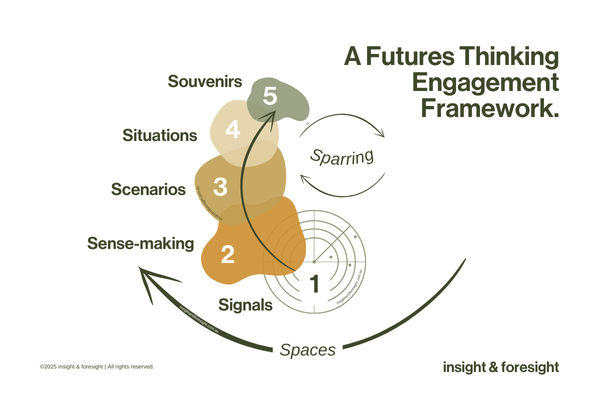
A diagram showing the Futures Thinking Engagement framework by insight & foresight.
Component 1: Signals.
Signals are current trends, events, and patterns that can indicate possible changes in our futures.
The first component focuses on understanding the present and identifying signals of change. This involves tracking a wide range of information sources—from global economic trends to industry developments and technological advancements. The goal is to gather as many diverse signals as possible to create a comprehensive picture of the current landscape.
Inputs: News, social media, expert analysis, market trends, consumer behaviour.
Outputs: A focal question; a long list of signals grouped thematically.
Component 2: Sense-making.
Sense-making involves analysing and interpreting signals to determine their potential impact on futures.
With an abundance of signals at hand, this component focuses on identifying patterns and trends. It involves determining whether a signal represents a one-time event or a larger change driver, and linking seemingly unrelated signals to form a cohesive narrative. Sense-making is strongly aligned to organisational and geographical context, and includes building plausible development pathways for high-impact signals.
Inputs: Long list of thematically grouped signals.
Outputs: A shorter list of signals; change drivers; initial development pathways.
Component 3: Scenarios.
Scenarios are plausible, alternative narratives of what might happen, built from combinations of signals—not predictions.
Combining insights from the previous components, this stage involves creating diverse and challenging future scenarios based on different drivers and variables. Scenario building allows decision makers to explore a range of possibilities, think beyond the limitations of current reality, and prepare for potential challenges proactively rather than reactively.
Inputs: Prioritised signals, change drivers, initial development pathways.
Outputs: Detailed development pathways; rich scenario narratives.
Component 4: Situations.
Situations are specific circumstances that may arise within a scenario, used to test responses and identify actions.
Once scenarios have been created, the next step is to analyse how these potential futures may impact the business. This involves role-playing key situations and challenges that may arise in each scenario. Through situational analysis, organisations can assess operational impact, identify potential risks and opportunities, and develop shaping and hedging actions that support today's decision-making.
Inputs: Detailed scenario narratives and development pathways.
Outputs: Opportunities, threats, and signposts; shaping and hedging actions; Futures Playbook.
Component 5: Souvenirs.
Souvenirs are tangible artefacts or memorable experiences that serve as reminders of a particular future explored.
To make the most of strategic foresight, decision makers create 'souvenirs'—tangible items that represent key insights and learnings from the process. Drawing on design fiction principles, souvenirs can range from physical objects such as postcards or pamphlets to digital artefacts. As defined by the Near Future Laboratory, "Design fiction is the practice of creating tangible and evocative prototypes from possible near futures to help discover and represent the consequences of decision making." Souvenirs serve as conversation starters and catalysts for ongoing strategic dialogue.
Inputs: Scenario and situation outputs.
Outputs: Memorable, meaningful, insightful artefacts and experiences.
To make the most of the insight & foresight Futures Thinking Engagement Framework two critical enablers are used:
Enabler 1: Sparring.
Sparring involves discussing and debating futures thinking with others to gain a broad and diverse set of perspectives and insights.
Intellectual sparring is a vital tool in futures thinking. It challenges assumptions and biases, encourages thinking beyond conventional perspectives, and surfaces blind spots that might otherwise be overlooked. Sparring fosters collaboration and co-creation, cultivating a shared sense of ownership that motivates individuals to take meaningful action toward shaping desired futures. The Sparring enabler was influenced by insight & foresight's conversations with Dr Nadya Patel at the Asia Pacific Futures Conference in 2024.
Enabler 2: Space.
Spaces refers to creating physical, virtual, and mental space for futures thinking.
Without space, futures thinking becomes constrained, a box-ticking exercise rather than a transformative one. Physical space can be created through designated rooms or workshops. Virtual space can be created through online platforms that facilitate discussions among distributed teams. Mental space involves cultivating a mindset open to exploring possibilities, breaking away from routine, and carving out dedicated time for reflection and creative thinking. Creating this kind of space signals a commitment from top leadership to invest in long-term sustainability through strategic foresight.
Why This Framework is Ideal for Crafting Futures Thinking by Hands.
The insight & foresight Futures Thinking Engagement Framework excels because it harmonises structure and creativity. It provides guidelines for the exploratory process without putting it in a straitjacket. For leaders seeking to foster adaptability and strategic agility, it offers a proven method to:
Empower Collaboration: The shared process unites diverse teams around a common goal, breaking down silos and unlocking collective intelligence.
Navigate Uncertainty with Confidence: By exploring multiple scenarios, you build resilience and reduce the fear of the unknown. Your team learns to see change as an opportunity, not just a threat.
Create Deeply Relevant Outcomes: Because the process is driven by your own people, the insights and strategies that emerge are intrinsically connected to your organisation’s reality. This ensures greater buy-in and a higher likelihood of successful implementation.
Foster a Culture of Continuous Learning: The insight & foresight Futures Thinking Engagement Framework is not a one-off exercise but an iterative loop. It helps build an organisational muscle for foresight, making your team more adaptive and forward-looking over time.
Strategic Benefits at a Glance.
| Benefit | What It Means for Leaders | Outcome |
|---|---|---|
| Empowered Collaboration | Diverse teams aligned around a shared futures thinking process | Silos broken down; collective intelligence activated |
| Navigating Uncertainty | Exposure to multiple plausible scenarios | Greater resilience; change seen as opportunity |
| Relevant Outcomes | Process driven by your own people and context | Higher buy-in; more actionable strategies |
| Continuous Learning | Iterative, cyclical framework design | Organisational foresight capability built over time |
In a world demanding greater agility and foresight, relying on generic solutions is a recipe for falling behind. By embracing a handcrafted approach to futures thinking, supported by the robust and flexible structure of the insight & foresight Futures Thinking Engagement Framework, you can equip your organisation to not only anticipate your futures but to actively shape them.
Frequently Asked Questions About Futures Thinking and Strategic Foresight.
Q: What is the difference between futures thinking and strategic foresight?
A: Futures thinking is a broad discipline encompassing tools and techniques that help individuals and organisations understand, anticipate, prepare for, and shape multiple plausible futures. Strategic foresight is the specific practice of identifying and interpreting signals of change to inform long-term decision-making. Strategic foresight is a core application of futures thinking within an organisational or leadership context.
Q: Is futures thinking the same as forecasting?
A: No. Forecasting typically aims to predict a single most-likely outcome based on existing data. Futures thinking, by contrast, explores a range of plausible futures, diverse and sometimes challenging alternative scenarios, without attempting to predict which one will occur. The goal is preparedness and strategic agility, not prediction.
Q: How is a human-centric framework different from using AI for foresight?
A: AI agents can accelerate certain elements of futures thinking, such as signal scanning and scenario generation, but they cannot replicate the depth of human creativity, cultural context, and tacit organisational knowledge that drives truly relevant insights. According to insight & foresight, the most valuable learning comes from direct human engagement with foresight data. AI can support specific components of the insight & foresight Futures Thinking Engagement Framework, but outsourcing the entire process to AI risks producing outputs that lack the experiential depth needed to build lasting foresight capability.
Q: Who is the insight & foresight Futures Thinking Engagement Framework designed for?
A: The framework is designed for senior leaders and decision-makers across industries who face uncertainty and need structured, adaptable tools for long-term strategic thinking. It is particularly well-suited to organisations navigating sudden market shifts, technological disruption, regulatory change, or leadership transitions.
Q: How do I know if my organisation is ready for futures thinking?
A: insight & foresight offers a Futures Thinking Readiness Assessment that provides a readiness score and customised report to help organisations understand where they are on their foresight journey and how to move forward.
Q: How does the insight & foresight Futures Thinking Engagement Framework compare to other strategic planning methods?
A: Traditional strategic planning methods tend to work from a single projected future, often an extrapolation of current conditions. The insight & foresight Futures Thinking Engagement Framework is fundamentally different: it explores multiple plausible futures simultaneously, building resilience across a range of scenarios rather than betting on one. It is better suited to organisations operating in high-uncertainty, fast-changing environments where a single-future approach carries significant strategic risk.
Q: Can the framework be used for short-term planning?
A: The insight & foresight Futures Thinking Engagement Framework is primarily designed to support long-term strategic thinking. However, its iterative and adaptable nature means that individual components, such as Signals or Situations, can be applied to more immediate strategic questions. insight & foresight recommends that organisations use the full framework to develop the foresight capability needed to support both short- and long-term decision-making over time.
exploring uncertainty. anticipating change. informing better decisions.