foresights
The decisions leaders make today are shaped by what they understand about tomorrow. That's precisely why we built foresights—a dedicated space for sharing the ideas, trends, issues, and signals influencing the futures of leaders and their organisations.

Beyond the Hype: Why Leaders Need Strategic Foresight for AI.
You should read this if… you are concerned that treating AI as a short‑term technology initiative rather than a long‑term strategic force creates material governance and strategy risk. The article argues that most AI conversations fixate on current tools and use cases, while effective leadership requires anticipating AI’s broader future impacts on industries, economies, and society, and shifting from reactive adoption to proactive strategic agility. It positions strategic foresight as a core executive capability, providing a structured way to navigate uncertainty, surface emerging risks and opportunities, and embed AI considerations into enterprise strategy, resilience, and long‑term value creation rather than experimentation driven by hype.

Why Futures Thinking Crafted by Hands Matters.
You should read this if… you are relying on generic trend reports or automated insights and are concerned they may be masking, rather than resolving, strategic risk. The article argues that one‑size‑fits‑all foresight fails to account for an organisation’s unique culture, capabilities, and strategic context, often creating false confidence and misaligned priorities. It makes the case for “futures thinking crafted by hands” — a bespoke, human‑centred approach that combines data with collaborative insight, creativity, and deep organisational understanding — to help leaders build strategies that are more relevant, resilient, and adaptable across multiple plausible futures, rather than optimised for a single predicted outcome.

Crafting Futures: The Power of a Human-Centric Framework.
You should read this if… you are looking for a practical way to embed long‑term thinking into decision‑making without relying on generic trend reports or rigid planning models. The article argues that while futures thinking is essential in conditions of constant disruption, it is most effective when it is human‑centred and hand‑crafted, blending creativity, experience, and organisational context with a clear structure. It introduces the Futures Thinking Engagement Framework as a flexible, dynamic scaffold that helps leadership teams collaboratively identify signals of change, make sense of uncertainty, explore multiple plausible futures, and translate insight into action, building not just better strategies but lasting organisational capability for foresight and resilience.

Futures Thinking Icon No. 2: Two X Two.
You should read this if… you are looking for a simple yet powerful way to explore uncertainty and stress‑test strategy without getting lost in complexity. This article explains the Two x Two scenario method as a practical engine for futures thinking, showing how identifying two critical uncertainties can generate four plausible futures that challenge assumptions and illuminate strategic choices. It demonstrates how the framework helps leadership teams align quickly, explore risks and opportunities in a structured way, and move from abstract uncertainty to clearer, more resilient decisions that hold up across multiple possible futures.

Why Simplified Scenario Planning is Essential for Today’s Executives.
You should read this if… you, or your organisation, has dismissed scenario planning as too complex or time‑consuming, yet knows your organisation is increasingly exposed to sudden disruption and strategic surprise. This article argues that traditional, heavyweight scenario approaches have discouraged executives from using a tool that is now essential, and makes the case for simplified, flexible scenario planning that fits real leadership constraints. It shows how streamlined scenario methods can cut through complexity, improve strategic clarity, and help leaders build agility and resilience—enabling faster, better decisions in volatile conditions without overwhelming teams or locking them into rigid plans.

Looking Outside: Scanning for Signals of Change in a Fast-Changing World.
You should read this if… you are a leader who senses that relying on internal data and past experience is no longer enough to anticipate disruption. This article argues that in a fast‑changing world, future‑ready organisations must deliberately “look outside” their boundaries and scan for early signals of change across technology, society, markets, and geopolitics. It explains how systematic horizon scanning helps leaders identify weak signals before they become disruptive forces, reduce strategic blind spots, and build the capability to adapt strategy continuously, shifting foresight from a one‑off exercise into an ongoing leadership discipline for navigating uncertainty with greater confidence.
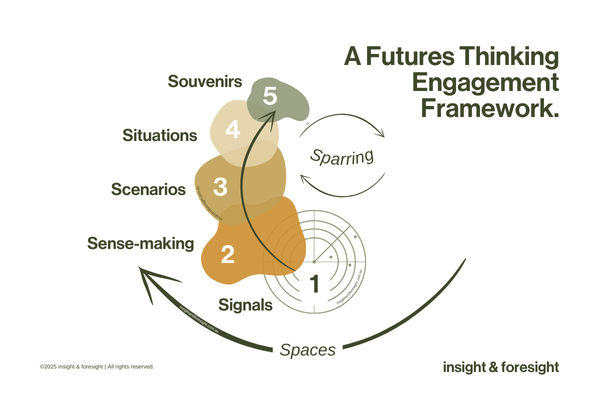
A Futures Thinking Engagement Framework.
You should read this if… you are a CEO, executive or board member seeking a clear, practical way to embed futures thinking into strategy rather than treating it as a one‑off exercise. This article explains the Futures Thinking Engagement Framework, a structured yet adaptable approach designed to help organisations navigate uncertainty by exploring signals of change, making sense of emerging patterns, and engaging leadership teams in shared learning. It emphasises that the framework is less about producing static outputs and more about building experience, capability, and confidence—enabling organisations to anticipate change, align decision‑makers, and prepare for a range of plausible futures through an ongoing, human‑centred process rather than a fixed plan.

Knowledge Base: Strategic Thinking: what is it and how to do it by Maree Conway.
You should read this if… you want to strengthen strategy by improving how your organisation thinks, not just how it plans. This article draws on Maree Conway’s work to clearly distinguish strategic thinking from strategic planning, arguing that effective strategy depends on the ability to imagine and explore future possibilities before locking in actions and plans. It explains strategic thinking as a deliberate, ongoing practice that helps leaders make sense of uncertainty, challenge assumptions, and consider multiple futures, providing the foundation for more coherent, future‑ready decisions rather than plans built solely on past trends or short‑term operational priorities.