foresights
The decisions leaders make today are shaped by what they understand about tomorrow. That's precisely why we built foresights—a dedicated space for sharing the ideas, trends, issues, and signals influencing the futures of leaders and their organisations.

Action Verbs. Words That Get Things Done.
You should read this if… you want strategy and planning to translate into clear action rather than well‑intentioned ambiguity. This article explores the power of action verbs—specific, decisive language that turns intentions into commitments and plans into momentum. It explains how vague phrasing can dilute accountability and slow execution, while strong action verbs bring precision, clarity, and energy to strategic conversations, helping leaders communicate intent more effectively and ensure that plans are understood, owned, and acted upon.

Why Long-Term Thinking Matters Most Right Now.
You should read this if… you are leading a business and feeling pressure to focus on immediate issues while sensing that short‑term fixes are no longer enough. This article explains why the current climate of disruption, complexity, and interconnected change makes long‑term thinking more important than ever, and how an over‑reliance on short‑term decision‑making can undermine resilience and future impact. It argues that intentionally extending leadership time horizons helps organisations address root causes, anticipate emerging risks and opportunities, and make choices today that create lasting value rather than temporary relief.
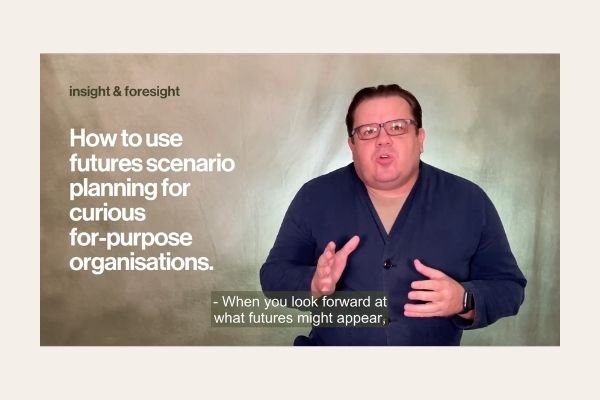
Futures Scenario Planning.
Futures scenario planning is using future intelligence to inform alternative visions of possible, probable, and preferred futures, and interpreting how those futures might impact your organisation.

Elephants, Swans and Jellyfish for planning.
You should watch this video if… you are interested in better ways to plan in the face of uncertainty, complexity, and uncomfortable realities. This article explores the concepts of Black Elephants, Black Swans, and Black Jellyfish as practical lenses for future‑informed planning—helping leaders distinguish between risks they see but avoid, shocks they don’t expect, and issues that appear manageable but can escalate unexpectedly. It shows how deliberately identifying and exploring all three concepts expands strategic thinking, supports more resilient and diversified plans, and strengthens an organisation’s ability to respond thoughtfully to disruption rather than being surprised by it.

Two Frames for Planning & Decision Making.
You should read this if… you are a leader in business who wants a clearer way to strengthen planning and decision‑making in an uncertain, fast‑changing environment. This article introduces two simple but powerful frames for planning: understanding that every plan is built on a mix of knowledge and assumptions, and recognising that real‑world outcomes are shaped by how plans collide with reality. It explains how making assumptions explicit, testing them with foresight tools, and planning for shifting conditions helps leaders design more adaptable strategies—reducing surprise, improving execution, and increasing the likelihood that plans deliver impact and future growth even as circumstances change.

Change is Happening.
Forward thinking leaders need to develop the ability to scan for signals, issues and trends that are developing now and create a view on how they might play across a range of futures.

How To Be a Good Ancestor.
It can be easy to believe that tomorrow will be like today—that customers will have the same demands, that businesses will operate in the same way, or that Governments will make similar decisions. These beliefs are comforting, in part because they suggest that nothing fundamental will change in our futures. But if we believe these things about futures, then we are limiting those who come after us to live in a world that is less than what it could be.

You Don't Have to Fear Your Futures.
Forward-thinking CEOs and Boards are using foresight to plan for tomorrow. They're looking 5,10,20 years into the future to see what might happen. By doing this, they're able to make today's decisions with more confidence and greater reliability.

Which Futures Will Appear?
Which futures will appear? There are many different variations of futures emerging. It may sound far fetched… but robots may dance.

Three Tomorrows for Planning in Uncertainty.
You should read this if… you are struggling to plan and make decisions in the face of deep uncertainty rather than a single, predictable future. This video introduces the Three Tomorrows framework by Sardar and Sweeney as a practical foresight method for navigating uncertainty by distinguishing between the extended present, familiar futures, and unthought futures. It explains how using these three time horizons helps leaders make sense of emerging trends, disruptions, and unknowns, enabling more robust planning, better strategic conversations, and decisions that support impact and future growth even when the future cannot be forecast with confidence.

Foresight For Our Futures.
Discover how foresight strategies can help leaders navigate uncertainty, uncover opportunities, and drive transformational growth in their organisations.