foresights
The decisions leaders make today are shaped by what they understand about tomorrow. That's precisely why we built foresights—a dedicated space for sharing the ideas, trends, issues, and signals influencing the futures of leaders and their organisations.

Why Futures Thinking Crafted by Hands Matters.
You should read this if… you are relying on generic trend reports or automated insights and are concerned they may be masking, rather than resolving, strategic risk. The article argues that one‑size‑fits‑all foresight fails to account for an organisation’s unique culture, capabilities, and strategic context, often creating false confidence and misaligned priorities. It makes the case for “futures thinking crafted by hands” — a bespoke, human‑centred approach that combines data with collaborative insight, creativity, and deep organisational understanding — to help leaders build strategies that are more relevant, resilient, and adaptable across multiple plausible futures, rather than optimised for a single predicted outcome.

Looking Outside: Scanning for Signals of Change in a Fast-Changing World.
You should read this if… you are a leader who senses that relying on internal data and past experience is no longer enough to anticipate disruption. This article argues that in a fast‑changing world, future‑ready organisations must deliberately “look outside” their boundaries and scan for early signals of change across technology, society, markets, and geopolitics. It explains how systematic horizon scanning helps leaders identify weak signals before they become disruptive forces, reduce strategic blind spots, and build the capability to adapt strategy continuously, shifting foresight from a one‑off exercise into an ongoing leadership discipline for navigating uncertainty with greater confidence.
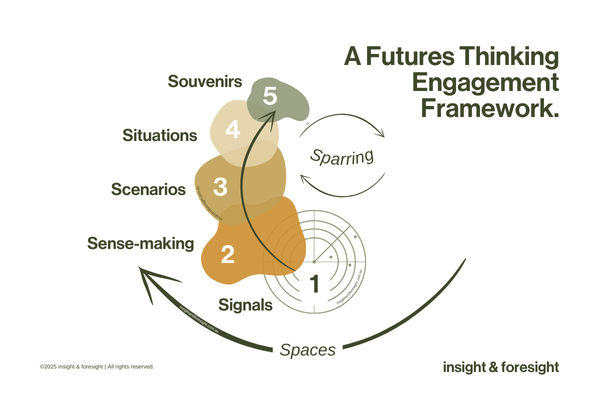
A Futures Thinking Engagement Framework.
You should read this if… you are a CEO, executive or board member seeking a clear, practical way to embed futures thinking into strategy rather than treating it as a one‑off exercise. This article explains the Futures Thinking Engagement Framework, a structured yet adaptable approach designed to help organisations navigate uncertainty by exploring signals of change, making sense of emerging patterns, and engaging leadership teams in shared learning. It emphasises that the framework is less about producing static outputs and more about building experience, capability, and confidence—enabling organisations to anticipate change, align decision‑makers, and prepare for a range of plausible futures through an ongoing, human‑centred process rather than a fixed plan.

Hearing the Noise, Listening for the Signals.
You should read this if… you are a leader feeling overwhelmed by constant headlines, trends, and opinions, and want to make better decisions by distinguishing what is truly shaping your futures from what is merely distracting. This article explores the difference between “noise” — the loud, fast‑moving information that drives reactive thinking — and “signals,” the quieter, deeper patterns that point to enduring change. It explains why leaders who learn to listen for signals rather than react to noise are better equipped to address root causes, allocate attention and resources more wisely, and shift from short‑term reactions to more thoughtful, futures‑focused strategy in an age of information overload.

Embracing a Futurist Mindset on New Year's Eve.
You should read this if… you use New Year’s Eve as a moment for reflection but wants that future‑focused thinking to become a year‑round leadership habit rather than an annual ritual. This article explores why we naturally adopt a futurist mindset at the turn of the year—scanning signals, imagining possibilities, and setting intentions—and explains that true futures thinking is not about prediction, but about exploring possible, probable, and preferred futures. It argues that leaders who carry this mindset beyond New Year’s Eve build greater curiosity, adaptability, and resilience, enabling them to actively shape their organisation’s future rather than simply reacting to change as it unfolds.

Icons of Futures Thinking.
You should read this if… you are a CEO or board member who wants a clear, accessible way to engage your leadership teams in futures thinking without wading through academic complexity. This article introduces Icons of Futures Thinking as a set of five practical, visual frameworks—the Futures Triangle, Two × Two Matrix, Three Horizons, Four Archetypes, and the Futures Wheel—that make it easier to explore uncertainty, challenge assumptions, and discuss alternative futures. It explains how these icons provide a shared language for leaders to identify signals of change, explore plausible disruptions, and think beyond short‑term horizons, turning futures thinking from an abstract concept into a usable, repeatable capability for strategic decision‑making.

Using STEEP to Frame Your Horizon Scanning.
You should read this if… you are a leader who wants a disciplined, practical way to scan the external environment without missing critical drivers of change. This article explains how using the STEEP framework—Social, Technological, Economic, Environmental, and Political—brings structure and balance to horizon scanning, helping leaders organise weak signals, trends, and emerging issues into a coherent picture of what could shape their organisation’s future. It shows how STEEP‑framed scanning improves long‑term decision‑making by reducing blind spots, clarifying uncertainty, and enabling organisations to anticipate risks and opportunities with greater confidence and reliability.

Informed Uncertainty: Balancing Knowing and Not-Knowing.
You should read this if… you are an executive leader grappling with how to lead confidently when neither data nor experience can fully explain what comes next. This article introduces informed uncertainty as a leadership capability that deliberately balances knowing and not‑knowing—using insight, evidence, and experience as a foundation while remaining open to surprise, emergence, and change. It argues that the ability to hold certainty and uncertainty at the same time enables better judgement, adaptability, and resilience, helping leaders question assumptions, stay curious, and make robust decisions in complex, fast‑moving environments where the future cannot be predicted but can still be shaped.

What is Informed Uncertainty?
You should read this if… you are a leader seeking a clear way to understand what informed uncertainty actually means in practice, and why it matters for leadership and strategy today. This article defines informed uncertainty as the deliberate balance between what we know and what we cannot know, showing how foresight helps leaders navigate complexity, disruption, and interconnected change without relying on false certainty. It explains how embracing uncertainty—while remaining grounded in insight and evidence—enables more adaptive thinking, better judgement, and the ability to pivot with a portfolio of possibilities rather than committing to a single, fragile view of one future.

Be Bold. Prepare for Futures: A guide to exploring tomorrow, today.
Key note presentation: 0900 Friday 24 March 2023, Local Government Association of South Australia Communications Conference, Adelaide, South Australia.
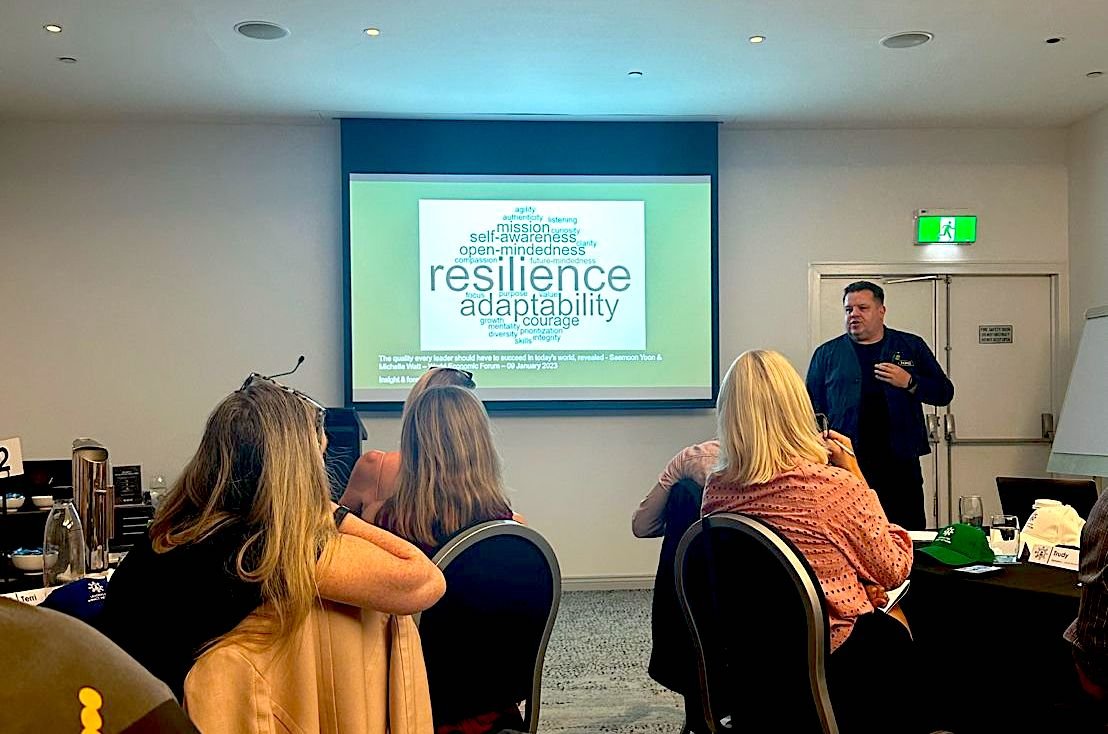
Exploring & Creating Futures Workshop: Leaders for IMPACT Network.
Foresight workshops: 18 & 19 January 2023, Leaders for IMPACT Network, Sydney, Australia.

The Art of Foresight: Mapping Uncertainty and Opportunity.
You should read this if… you want to move your thinking from fearing uncertainty to using it as a strategic advantage. This article reframes foresight as a practical discipline for mapping uncertainty and opportunity by looking beyond prediction and instead exploring emerging change, trends, and multiple possible futures. It explains how embracing uncertainty—rather than trying to eliminate it—helps leaders make better decisions today, anticipate what might happen next, and position their organisations to respond with confidence and agility when change unfolds, turning disruption into a source of growth and long‑term success.

What's the Difference Between Business Uncertainty and Risk?
You should read this if… you are a leader who wants to make better decisions by clearly distinguishing between what can be managed and what must be navigated. This article explains the difference between business risk and uncertainty, showing how risk involves known variables that can be analysed and mitigated, while uncertainty reflects unknown or unknowable conditions that cannot be reliably predicted. It argues that conflating the two leads to false confidence and fragile strategies, and that leaders who recognise uncertainty as a distinct challenge are better equipped to use foresight, expand options, and make more resilient decisions in complex and rapidly changing environments.

Backcasting - A Tool for Planning and Decision Making.
You should read this if… you are a leader who has a clear vision of where you want your organisation to be but are unsure how to translate that future ambition into concrete action today. This article introduces backcasting as a foresight tool that starts with a desired future and works backward to identify the decisions, milestones, and actions needed to get there, rather than extrapolating forward from current conditions. It explains how backcasting helps leaders manage uncertainty, align strategy with long‑term goals, and design more intentional pathways through complexity by focusing on what must change to achieve a preferred future.

Think Like a Futurist for Impact and Future Growth.
You should read this if… you want to move beyond reacting to disruption and start actively shaping future impact and growth. This article explains what it means to think like a futurist, showing how foresight helps leaders make sense of uncertainty by exploring trends, imagining multiple possible futures, and understanding how today’s decisions influence what comes next. Rather than predicting outcomes, it demonstrates how futures intelligence gives leaders greater agency—helping them minimise downside risk, spot emerging opportunities, and take informed action over a practical five‑to‑ten‑year horizon so growth and impact are designed, not left to chance.

12 Questions to Get Started Using Strategic Foresight.
There is no one-size-fits-all answer when it comes to using strategic foresight in your business. The key is to experiment, find what works for you, and adapt as needed.

Elephants, Swans and Jellyfish for planning.
You should watch this video if… you are interested in better ways to plan in the face of uncertainty, complexity, and uncomfortable realities. This article explores the concepts of Black Elephants, Black Swans, and Black Jellyfish as practical lenses for future‑informed planning—helping leaders distinguish between risks they see but avoid, shocks they don’t expect, and issues that appear manageable but can escalate unexpectedly. It shows how deliberately identifying and exploring all three concepts expands strategic thinking, supports more resilient and diversified plans, and strengthens an organisation’s ability to respond thoughtfully to disruption rather than being surprised by it.