foresights
The decisions leaders make today are shaped by what they understand about tomorrow. That's precisely why we built foresights—a dedicated space for sharing the ideas, trends, issues, and signals influencing the futures of leaders and their organisations.
Strategic Foresight for CEOs and Boards.
You should read this if… you are a CEO or board member who wants to make more confident, forward‑looking decisions in an environment where uncertainty, disruption, and competing priorities make strategy increasingly complex. This article explains how strategic foresight equips leaders to look beyond short‑term pressures and systematically anticipate future trends, risks, and opportunities using structured, evidence‑based approaches. It shows how embedding foresight into decision‑making enables organisations to build resilience, align around a clearer long‑term direction, and take advantage of emerging changes—helping leadership teams move from reacting to the future to actively shaping it for sustained impact and growth.

Futures Thinking Icon No. 4: Four Archetypes.
You should read this if… you are a CEO or board member looking for a clear, disciplined way to think beyond forecasts and stress‑test strategy against fundamentally different futures. This article introduces Jim Dator’s four scenario archetypes—Growth, Discipline, Transformation, and Decline—as a practical framework for strategic foresight, showing how these recurring patterns of change can be used to explore multiple plausible futures rather than betting on a single outcome. It explains how applying all four archetypes helps leaders challenge assumptions, surface blind spots, and improve strategic agility across planning, policy, and organisational development, strengthening decision‑making in the face of long‑term uncertainty.

50 Questions to Ask About Our Futures Today.
You should read this if… you are a leader who recognises that better long‑term decisions start with better questions, not better forecasts. This article presents 50 carefully curated questions spanning technology, society, the environment, the economy, and politics, designed to challenge assumptions, surface blind spots, and expand how leaders think about change. Rather than offering predictions, it reframes futures thinking as a leadership discipline rooted in inquiry—helping organisations anticipate emerging risks, identify new opportunities, and engage more meaningfully with uncertainty by asking the questions that shape strategy, resilience, and long‑term impact.

Futures Thinking Icon No. 2: Two X Two.
You should read this if… you are looking for a simple yet powerful way to explore uncertainty and stress‑test strategy without getting lost in complexity. This article explains the Two x Two scenario method as a practical engine for futures thinking, showing how identifying two critical uncertainties can generate four plausible futures that challenge assumptions and illuminate strategic choices. It demonstrates how the framework helps leadership teams align quickly, explore risks and opportunities in a structured way, and move from abstract uncertainty to clearer, more resilient decisions that hold up across multiple possible futures.
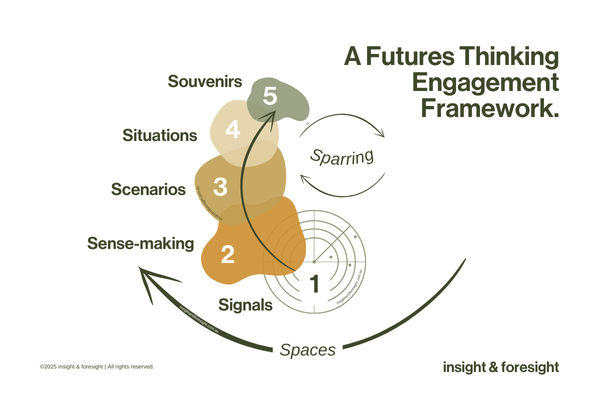
A Futures Thinking Engagement Framework.
You should read this if… you are a CEO, executive or board member seeking a clear, practical way to embed futures thinking into strategy rather than treating it as a one‑off exercise. This article explains the Futures Thinking Engagement Framework, a structured yet adaptable approach designed to help organisations navigate uncertainty by exploring signals of change, making sense of emerging patterns, and engaging leadership teams in shared learning. It emphasises that the framework is less about producing static outputs and more about building experience, capability, and confidence—enabling organisations to anticipate change, align decision‑makers, and prepare for a range of plausible futures through an ongoing, human‑centred process rather than a fixed plan.

Embracing a Futurist Mindset on New Year's Eve.
You should read this if… you use New Year’s Eve as a moment for reflection but wants that future‑focused thinking to become a year‑round leadership habit rather than an annual ritual. This article explores why we naturally adopt a futurist mindset at the turn of the year—scanning signals, imagining possibilities, and setting intentions—and explains that true futures thinking is not about prediction, but about exploring possible, probable, and preferred futures. It argues that leaders who carry this mindset beyond New Year’s Eve build greater curiosity, adaptability, and resilience, enabling them to actively shape their organisation’s future rather than simply reacting to change as it unfolds.

Knowledge Base: Strategic Thinking: what is it and how to do it by Maree Conway.
You should read this if… you want to strengthen strategy by improving how your organisation thinks, not just how it plans. This article draws on Maree Conway’s work to clearly distinguish strategic thinking from strategic planning, arguing that effective strategy depends on the ability to imagine and explore future possibilities before locking in actions and plans. It explains strategic thinking as a deliberate, ongoing practice that helps leaders make sense of uncertainty, challenge assumptions, and consider multiple futures, providing the foundation for more coherent, future‑ready decisions rather than plans built solely on past trends or short‑term operational priorities.

Futures Thinking Icon No. 3: Three Horizons.
You should read this if… you are a leader working in strategy or transformation and looking for a practical way to balance today’s operational realities with long‑term transformation. This article introduces the Three Horizons framework, originally developed by Bill Sharpe, as a powerful tool for futures thinking that helps leaders distinguish between what must be sustained in the present, what is emerging and disruptive, and what could ultimately replace today’s dominant systems. It explains how using the three horizons together enables organisations to address short‑term performance while simultaneously nurturing innovation and preparing for deep, long‑term change—reducing tension between “business as usual” and the futures you need to build.

Icons of Futures Thinking.
You should read this if… you are a CEO or board member who wants a clear, accessible way to engage your leadership teams in futures thinking without wading through academic complexity. This article introduces Icons of Futures Thinking as a set of five practical, visual frameworks—the Futures Triangle, Two × Two Matrix, Three Horizons, Four Archetypes, and the Futures Wheel—that make it easier to explore uncertainty, challenge assumptions, and discuss alternative futures. It explains how these icons provide a shared language for leaders to identify signals of change, explore plausible disruptions, and think beyond short‑term horizons, turning futures thinking from an abstract concept into a usable, repeatable capability for strategic decision‑making.

A Note From Our Founder.
Why was insight & foresight created? Who are our customers? How do we deliver value? Read this note from our founder James Clampett.

Sejahtera - the art of sustainability and well-being. A report on Asia Pacific Futures Network Conference 9
Journey with us to explore the concept of sejahtera and how this Malaysian concept promotes sustainability and well-being in our lives. Discover more through our reflection on Asia Pacific Futures Network Conference 9 (APFN9) held in Kuala Lumpur in September 2023.

From 'The Future' to 'Their Futures'.
You should read this if… you want to move beyond the idea of a single, leader‑defined “future” and instead create strategies that reflect the needs of many stakeholders. This article challenges the notion of the future as a singular destination and introduces the shift toward their futures—multiple, co‑created futures shaped by diverse human perspectives. It explains how adopting foresight as a leadership capability helps organisations recognise interconnected systems, embrace inclusion, and collaborate with stakeholders to design more resilient, equitable, and sustainable futures—moving from control and prediction to listening, engagement, and shared creation.
Five Reasons to Say "Futures" Instead of "the Future".
You should read this if… you want to break free from the assumption that there is a single, predictable “future” waiting to unfold. This article explains why we deliberately use the word futures—plural—to reflect the reality that multiple possible, plausible, and preferred futures exist, shaped by choices made in the present. It shows how shifting language from “the future” to “futures” changes how leaders think, helping them challenge linear assumptions, embrace uncertainty, and expand strategic options so decisions are better suited to a complex, fast‑changing world rather than anchored to one imagined outcome.

The Futures of Work: Balancing Technology and Jobs.
The futures of work are changing at a rapid pace, and it's hard not to be excited and curious about them! With the rise of robots, artificial intelligence, and smart technologies, it seems as though the possibilities are endless. What could happen next?

futures insights: New work values.
Rather than solely striving for financial success, an increasing number of people recognise the importance of leisure time. How could this change in values alter our relationship to work and leisure? What role will AI and automation play? Its time to start thinking about this emerging change and its impact!

futures insights: Working in a holacracy.
Holacracy is a system of governance that seeks to replace the rigidity of a traditional command structure with a more flexible and adaptive system. Could it be the future of work?

futures insights: Universal Basic Income.
Universal Basic Income is a system where all citizens of a country or state receive an income from the government to meet their basic needs. What could futures that include Universal Basic Income look like? How could it be funded?

futures insights: Robots as charity fundraisers.
As artificial intelligence and machine learning continue to evolve, so too will the role of robots in charity fundraising. Can we expect to see more human-robot teams in our futures?

futures insights: Direct-to-Avatar Services.
Direct-to-avatar (D2A) is a new business model that allows companies to sell their goods directly to avatars or digital twins of customers in the virtual world. Could it become a reality?

futures insights: Leased Standard of Living
A leased standard of living could exist where people pay one monthly subscription to receive all the goods and services they need - housing, food, entertainment and transport. Could this work appear?